
Cozumel's Paradise Lost: Cruise Ships, Sewage, and the Fight to Save the Reef

In 1961, Jacques Cousteau visited Cozumel and called it paradise. The coral formations were, in his own account, as complete as they could be — colonies three meters long, one after another, until "everything was reef."
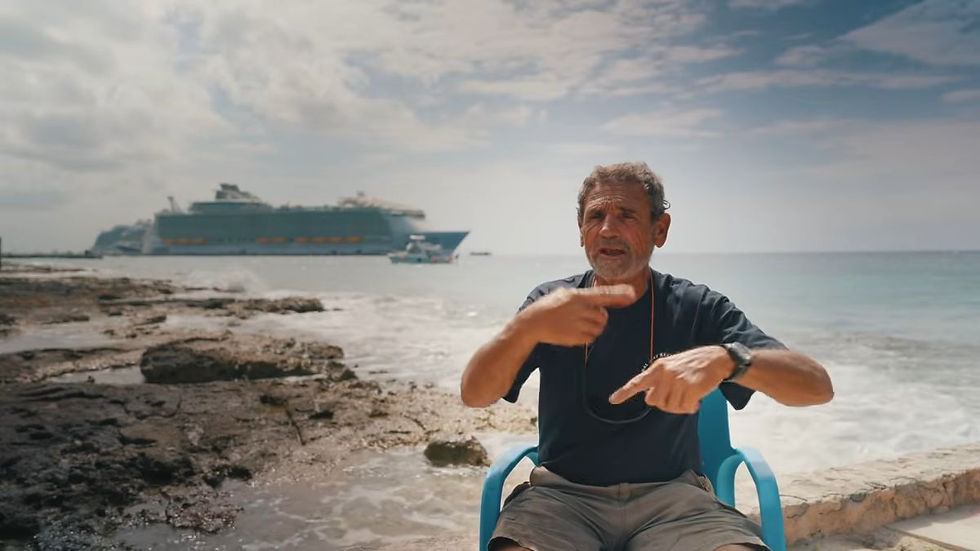
CCRRP volunteer Alexander Helff's documentary, Cozumel – Paradise Lost, sets out to answer a hard question: what happened between then and now? The film spends thirty minutes tracing the answer back to two things above all — the cruise ship industry, and the infrastructure that was never built to support it. Here's what it found.
The scale of the cruise ship industry
Cozumel has around 100,000 residents. It also receives close to 5 million cruise ship visitors a year — in 2024 alone, more than 1,280 ships brought over 4.6 million passengers, making it the 4th busiest cruise port destination in the world. Three terminals (Punta Langosta downtown, the International Cruise Terminal, and Carnival's Puerta Maya) can handle up to seven ships docked at once.
That scale didn't happen by accident, and it came at a direct cost to the reef. In 1980, the island's southwest coast — from downtown to the island's end — was a protected area. In 1994, a pier was built inside that protected zone, and the protected boundary was simply redrawn south to accommodate it. Heavy machinery drove concrete pillars straight into the reef; nearly all of the surrounding coral was killed in the process. What's left today, in Dr. Mendez's words in the film, is often mistaken by first-time visitors for a healthy reef: "it's just the rock and some organisms."

How cruise ships spread coral disease
One of the film's more striking claims is about ballast water — the seawater cruise ships take on to stay stable, then discharge on arrival. A ship loads ballast water in a port like Miami, carries it to Cozumel, and dumps it, pathogens and marine life included.
The documentary connects this directly to Stony Coral Tissue Loss Disease (SCTLD), a highly lethal coral disease first identified off Florida in 2014. Ordinarily, the Gulf Stream would carry it north into cooler water. But with Port Miami and Port Canaveral among the busiest cruise ports on Earth, the film argues it was only a matter of time before ship traffic spread the disease south, against the current, throughout the Caribbean. In 2018, over 60% of Cozumel's corals died from SCTLD — affecting 22 of the reef's 35 coral species, including total losses of species like pillar coral and deep-water brain coral. Corals a thousand years old died within a month.

Propellers, sediment, and a reef that can't breathe
It isn't just disease. Every time a cruise ship arrives or leaves — often parking in reverse, using propellers 5 to 7 meters in diameter in shallow water — it stirs up sediment from the seabed. That sediment settles on nearby coral, blocking the sunlight coral needs for photosynthesis and slowly suffocating it. It's a process that repeats every single day ships are in port, which in Cozumel is most days.
Beach clubs, sewage, and a marine park with no real authority
Cruise passengers need somewhere to go for their few hours ashore, and the answer has mostly been beach clubs on the island's west side — the same stretch of sandy coast that fronts the marine park, many of them owned by the cruise companies themselves. In 2018, there were 53 beach clubs and 103 septic tanks along that coastline. By 2024: nearly 100 beach clubs and 180 septic tanks.
The marine park's jurisdiction stops 20 meters from the beach — everything beyond that line is effectively unregulated. Most of these beach clubs aren't connected to any sewage system; they rely on septic tanks dug into porous limestone, which leaches nutrient-rich waste — nitrates, phosphates, nitrites — straight into the ocean. Those nutrients feed macroalgae, which grows roughly a centimeter a day. Coral grows about a centimeter a year. The math is not close: algae overgrows and kills the coral beneath it. On top of that, chemical pollution — sunscreen among it — coats coral in a layer that blocks the sunlight it depends on.

The water treatment plant that hasn't changed since 1982
This is the infrastructure story underneath all of it. San Miguelito, the island's only water treatment plant, was already there when Dr. Mendez arrived in Cozumel in 1982 — and by 2024, it's the same plant, serving roughly eight times the population it was built for (from 20,000 people to 160,000). It leaks. Everything north of the treatment plant is supposed to be protected area; everything behind the plant, the film shows, is dead mangrove, all the way to the end of the island.

Why the mangroves matter
The mangrove forest on Cozumel's north side is a UNESCO-protected wetland — a nursery for fish and crustaceans, a nesting site for birds like ospreys, a storm barrier, and a carbon sink. Its roots trap sediment and pollutants before they ever reach the reef or seagrass beds. It's also directly threatened by the same failing infrastructure.
On the island's south side, at Parque Écologico Laguna Colombia, park manager José Benavides has been running mangrove restoration with local volunteers since 2005 — since the very beginning, with groups of Cozumel's children and young people. The work is physical: restoring hydrological flow channels, raising ground elevation with sand pulled from those same channels, keeping water circulating rather than stagnant. As Benavides puts it in the film: "If the mangroves are living, the reef will also live."

The dolphinarium finding nobody could talk about
The film also revisits an older investigation by Dr. Thomas Goreau, who was asked years ago to look into unusually high algae levels near one of Cozumel's two dolphinariums. He traced the algae, swimming along the reef, straight to the dolphin pens. His math: a dolphin excretes roughly as much waste as five to ten people, so a pen holding ten dolphins is, in nutrient terms, equivalent to 50–100 people's waste entering the water in one place. When he reported this, he says he was told he wasn't allowed to discuss it — it was "a political issue, not a scientific issue."

Climate change on top of everything else
Even without any of the above, Cozumel's reefs would still be facing the same crisis as reefs worldwide. 2023 brought Cozumel's first bleaching event of its kind — by Dr. Mendez's account, something he'd never seen in all his years there. 2024 repeated it. CCRRP now spends part of each year installing shade material (letting through about 70% of light) over vulnerable coral to reduce heat stress — a measure that can protect a handful of colonies, but not the 30 kilometers of reef Cozumel actually has.
The global numbers the film cites are stark: even if warming is held to 1.5°C, coral cover is projected to decline by 90%; at 2°C, that figure rises past 99%. Coral reefs, worldwide, are on track to be among the first ecosystems lost entirely to climate change.

The Threat Of The Fourth Pier
All of this frames the film's central conflict: a fourth cruise pier, proposed for the exact stretch of reef where CCRRP does its restoration work. The planned dock is 14 meters wide, extending 300 meters out and 800 meters along the coast — directly through water marked by CCRRP's restoration buoys, water that includes coral roughly 200 years old, including Acropora palmata, a legally protected species. The developer's 450-page environmental impact study doesn't mention the endangered species living there; by its account, there's nothing at the site that would stop construction.
The fight has been running for years. Mexico's environmental authority approved the project in December 2021; four months later, a federal judge halted construction after an injunction from a citizen collective. Years of conflicting court rulings followed, alongside continued protest, including peaceful underwater demonstrations at the proposed site. In June 2025, the developer moved to start construction anyway, deploying a testing platform — which more than 50 boats surrounded in protest, while underwater footage captured soil testing on the seabed. Under public pressure, the company announced a temporary suspension in July 2025; that same month, a federal court ordered a provisional halt. Mexico's president later stated that no permit had actually been granted. You can follow the full timeline of the Fourth cruise terminal.
Through all of it, CCRRP's volunteers keep working — installing new coral nurseries, surveying reef health, propagating fragments — because, as the film puts it: "All this damage, it is human damage. And how can it be reverted? Also by humans."

What restoration actually looks like, day to day
The film follows Dr. Mendez and CCRRP's volunteers through the actual mechanics of the work: cleaning algae off nursery corals with brushes (only ever enough to cover a small area — the rest of the reef is left to its own fate); running 10-meter transect surveys to measure live coral cover; mixing two-part epoxy to attach "corals of opportunity" (fragments already broken by divers, snorkelers, or storms) back onto the reef; and fragmenting healthy donor coral onto suspended strings, where better light and water flow speed up growth before the fragments are transplanted back onto damaged reef.

It's worth being honest about what this can and can't do. As the film notes, restoration doesn't stop coral from dying — without addressing warming and pollution, restored coral dies just like wild coral. What it can do is protect key reef areas that matter for fish nurseries and coastal protection, buy time, and prove — visibly, one coral at a time — that the damage isn't irreversible if people choose to act.
The fourth pier the film shows Dr. Mendez standing on the future site of — the one planned right through this same restoration area — has since been fought to a stop.


Comments